How much lead time should the expo build into each station call on a mixed line?
Fire times only work if the expo knows how long each station really takes. Here is how to measure station lead times, stagger calls, and adjust when the line changes.
Lead time is a station property, not a menu property
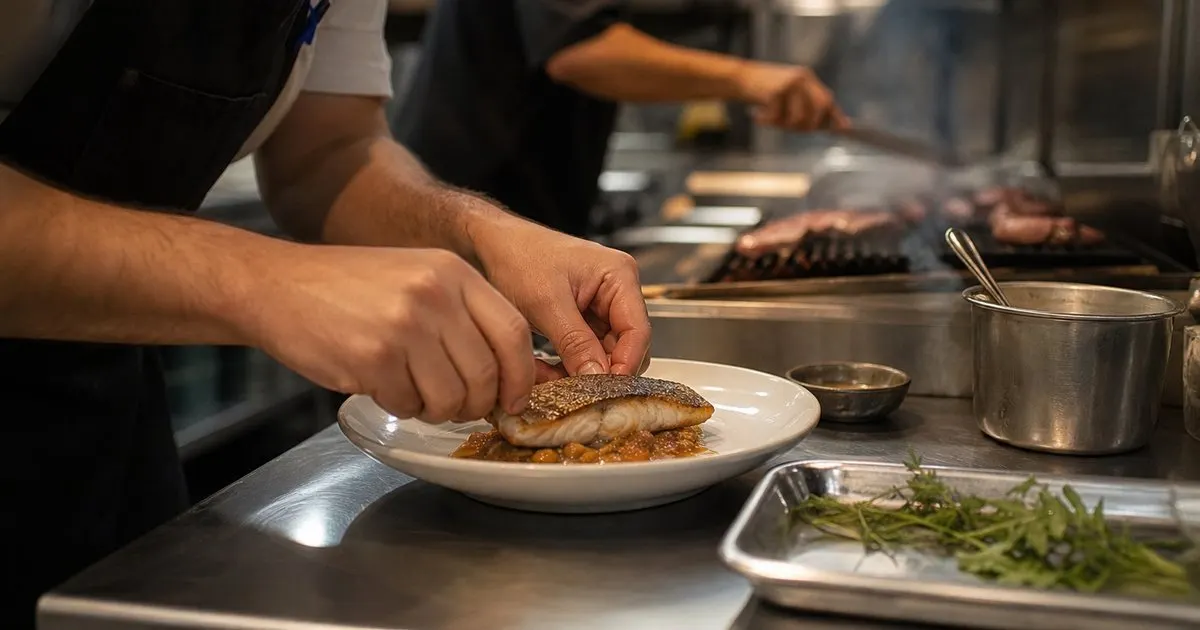
Most kitchens think about cook time per dish: the steak takes twelve minutes, the pasta takes seven. That is useful, but the number the expo actually needs is the lead time per station under load, which is the gap between the call and the plate landing in the window when that station has its typical number of tickets working. A grill with two steaks on it and a grill with nine steaks on it have very different lead times for the same dish, and the expo who calls the same fire time in both cases will get a table that arrives in pieces.
The practical way to think about it is that each station has a base time (the dish with nothing else working) and a load penalty (how much slower it gets per additional ticket). Sauté and grill tend to have steep load penalties because they are limited by burners and grate space. Cold stations typically have flatter penalties because they can batch. Fry batches well too, but only up to basket capacity: the penalty stays flat while there is basket room, then climbs sharply once every basket is full and oil temperature has to recover between drops, which is why the fryer so often turns into the weekend bottleneck. Once the expo has a rough feel for both numbers per station, the fire call becomes arithmetic rather than instinct, and a new expo can be taught it in a week instead of a season. Related: How do you route kitchen tickets to the right stations without chaos?
Keep reading: How do you route kitchen tickets to the right stations without chaos?, What is the best way to pace courses so a table eats together?, Why does the expo pass fall apart during a busy dinner rush?. See how PlatePassr helps you kitchen expo ticket routing and course pacing.
Measure it in real service, not on a quiet afternoon
To get honest lead times, time the station during a real service, from the moment the expo calls the fire to the moment the plate is in the window. Do it for a dozen tickets per station across a busy stretch and a slow stretch, and write down how many tickets the station had working each time. You are not looking for a precise average. You are looking for the shape: the slow station's lead time at typical load, the fast station's, and how much each one stretches when they are slammed. A clipboard at the pass for two services is usually enough. Related: Why does the expo pass fall apart during a busy dinner rush?
If you run a kitchen display system that records fire and bump times, this data already exists and you should pull it before service rather than guessing. The numbers will surprise you in at least one place. Kitchens frequently discover that the station they thought was slowest is fine, and the station that always seems calm is quietly the one holding tables because it batches and then releases everything at once. Whatever you find, the point is to replace a shared assumption with a measured number.
Stagger calls backward from the slowest station
With lead times in hand, the expo works backward from the plate that takes longest. If grill needs nine minutes at current load and sauté needs five, the expo fires grill, waits roughly four minutes, then fires sauté, so both land together. Fry and cold get called last, with just enough time to finish. The safety buffer, the extra minute or so the expo adds so that one plate is never the thing everyone is waiting on, belongs on the slow station only. Adding buffer to every station just makes the whole table late. Related: What is the best way to pace courses so a table eats together?
The stagger has to move as the load moves. A common failure is an expo who learned that grill is nine minutes on a Tuesday and calls nine minutes on a Saturday when grill is actually at fourteen. The fix is a habit, not a number: before each fire, glance at how many tickets the slow station has working and adjust. Some kitchens keep a simple mental rule like adding a minute for every two tickets over normal, which is crude but far better than a fixed time. Software that reads current station load and suggests the stagger removes the guessing, which is what PlatePassr's pacing does, but the habit matters more than the tool.
Re-measure whenever the line changes
Lead times drift. A new cook on sauté, a new dish that ties up the flat top, a broken burner, a seasonal menu with more items on one station: each of these shifts the numbers, and the expo's calls will be wrong until someone notices. Build a re-measure into every menu change and every significant staffing change. It does not need to be formal. Two services with a clipboard, or a look at last week's fire-to-bump data, is enough to catch a station that moved from five minutes to eight.
Share the numbers with the line, not just the expo. When the grill cook knows the expo is calling based on a measured nine minutes, and knows that the number came from timing their station, the fire calls stop feeling arbitrary and the cook starts telling the expo when the number is off: "I'm at twelve tonight, the walk-in steaks are cold." That two-way conversation is what keeps lead times honest between measurements, and it only happens when the line understands where the calls come from. Related: When should the expediter fire the entrees for a large party?
- The number that matters is station lead time under load, not dish cook time on paper.
- Time each station in real service, with a note of how many tickets it had working, to find the true shape.
- Stagger calls backward from the slowest station and put the safety buffer there alone.
- Re-measure after every menu or staffing change and share the numbers with the cooks.

Julien Jimenez
Julien Jimenez is an independent software builder based in Paris. He designs, ships, and operates focused SaaS products for small businesses and independent professionals. Read the full author page.
Send Every Ticket to the Right Station
Kitchen expo ticket routing and course pacing. PlatePassr is built to help you put this into practice.
Start free trialMore from the PlatePassr blog
How do you route kitchen tickets to the right stations without chaos?
What is the best way to pace courses so a table eats together?
Why does the expo pass fall apart during a busy dinner rush?
Get the PlatePassr playbook
Practical guides on kitchen expo and service, straight to your inbox as we publish them. No spam, unsubscribe any time.