Which expo callouts actually keep a line synchronized when the printer never stops?
A busy pass runs on a small vocabulary. Here are the calls that carry information, the ones that are noise, and how to make the whole line respond the same way.
The pass runs on five kinds of calls
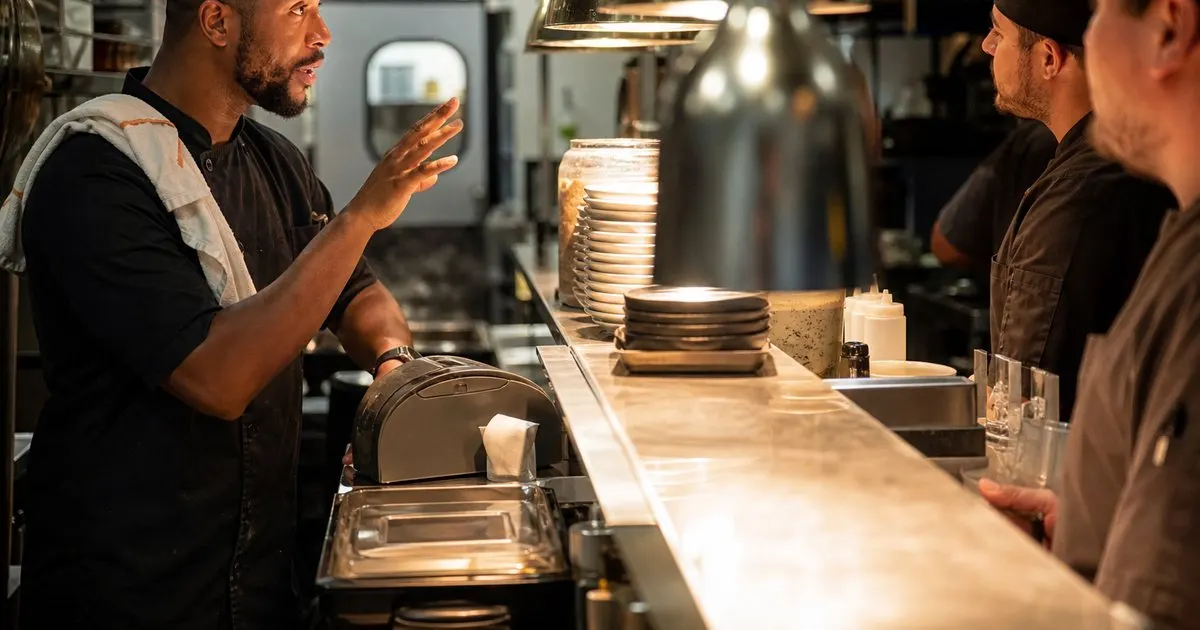
Strip away the personality and most expo communication falls into five categories: fire (start cooking this now), all day (here is the total of an item across all working tickets), hold (do not start or do not plate), refire or recall (this plate needs to be made again or is being pulled), and hands (someone come take this). Those are the calls that synchronize cooking. Status and availability calls like 86, working, and walking sit alongside them and answer questions rather than start or stop anything, and they should be short and standardized too. Everything beyond those two groups is either a variation of the five or noise. A line that responds cleanly to all five can handle almost any service. A line that has thirty different phrases for the same five ideas spends its attention decoding instead of cooking.
The reason the vocabulary matters more when the printer never stops is bandwidth. Under heavy load, cooks are listening with a fraction of their attention. A call has to be recognizable from its first word, carry the essential detail in the next three or four, and be finished before the next pan needs flipping. Long, conversational calls get heard as tone rather than content. The expo who says "Hey, can you go ahead and get started on the two ribeyes for the eight-top" is heard as something about ribeyes. The expo who says "Fire two ribeye, mid-rare, table twelve" is heard exactly. Related: What is the best way to pace courses so a table eats together?
Keep reading: How do you route kitchen tickets to the right stations without chaos?, What is the best way to pace courses so a table eats together?, Why does the expo pass fall apart during a busy dinner rush?. See how PlatePassr helps you kitchen expo ticket routing and course pacing.
Structure every call the same way
The structure that survives noise is: call type, quantity, item, critical modifier, table or seat. "Fire two salmon, one no sauce, twenty-one." "All day, six fries." "Hold table nine." "Refire one burger, medium, seat three." The call type comes first because it tells the cook what to do before they know what it is about. The quantity comes before the item because cooks grab pans by count. The modifier only appears if it changes the cook, not the garnish. The table or seat comes last because it is needed at plating, not at the start.
The repeat-back is the other half. The cook echoes the call in short form: "Two salmon, heard." That echo tells the expo the call landed and frees the expo to move to the next ticket. Without it, the expo either repeats the call (wasting bandwidth) or assumes it was heard (and finds out at the window). A line where every fire gets a heard is remarkably quiet compared to one where the expo keeps checking, because there is nothing to check. Make the repeat-back a rule, not a courtesy.
All day calls, and why they are the one to get right
The all day call is the one that keeps stations synchronized across tickets rather than within a ticket. When the expo says "all day, five chicken," the grill cook knows the total demand right now and can batch, sequence pans, and plan grate space without reading every ticket. On a busy stretch it is the most valuable thing the expo says. It also goes wrong the most, because the expo has to keep the count correct as tickets arrive, plates go up, and refires happen. An all day that is off by two makes the station either overcook or scramble. Related: How do you route kitchen tickets to the right stations without chaos?
Call all day at consistent moments, not randomly: when a new ticket arrives that adds to a station's load, and when the station asks. Say the new total, not the change (all day five chicken, not two more chicken), because the cook needs the total to plan and may have missed the previous number. If the kitchen display shows a live all day count per station, that call becomes a confirmation rather than the only source of truth, which reduces the error rate considerably. Keeping that count accurate in real time is one of the small things software does better than a human at the pass, and it is one of the pieces of PlatePassr we care about most. Related: Who owns the expo pass and how does that role actually work?
Calls that are noise, and how to remove them
Some calls sound useful and are not. Behind and hot are safety calls, not expo calls, and they belong to whoever is moving. Asking how long on the pasta is a question, not a call, and a display or a glance at the station usually answers it faster. Narrating the ticket as it prints (okay, we have a table of four, two apps, then...) is noise unless it ends in a fire. And repeating a call that has already been heard, because the expo is anxious, trains the line to ignore the first call and wait for the second.
To trim the vocabulary, sit down after a service and list every kind of thing the expo said. Sort them into the five categories, then look at what is left. Most of the leftovers can be deleted or turned into one of the five. Write the standard structure on a card at the pass for new expos, and have the line practice repeat-backs in a slow pre-shift service. A quiet pass with a small vocabulary is not a sign that nothing is happening. It is a sign that every call is being heard the first time. Related: Why does the expo pass fall apart during a busy dinner rush?
- Almost every useful expo call is a fire, an all day, a hold, a refire, or a hands call.
- Structure every call as type, quantity, item, critical modifier, table, and require a short repeat-back.
- All day calls synchronize stations across tickets; always say the new total, not the change.
- Cut narration, repeated calls, and questions that a glance would answer.

Julien Jimenez
Julien Jimenez is an independent software builder based in Paris. He designs, ships, and operates focused SaaS products for small businesses and independent professionals. Read the full author page.
Send Every Ticket to the Right Station
Kitchen expo ticket routing and course pacing. PlatePassr is built to help you put this into practice.
Start free trialMore from the PlatePassr blog
How do you route kitchen tickets to the right stations without chaos?
What is the best way to pace courses so a table eats together?
Why does the expo pass fall apart during a busy dinner rush?
Get the PlatePassr playbook
Practical guides on kitchen expo and service, straight to your inbox as we publish them. No spam, unsubscribe any time.